You’re offline. This help page still works as a reference. A fresh AI diagnosis needs an internet connection.
Appliance help
Fridge-freezer help
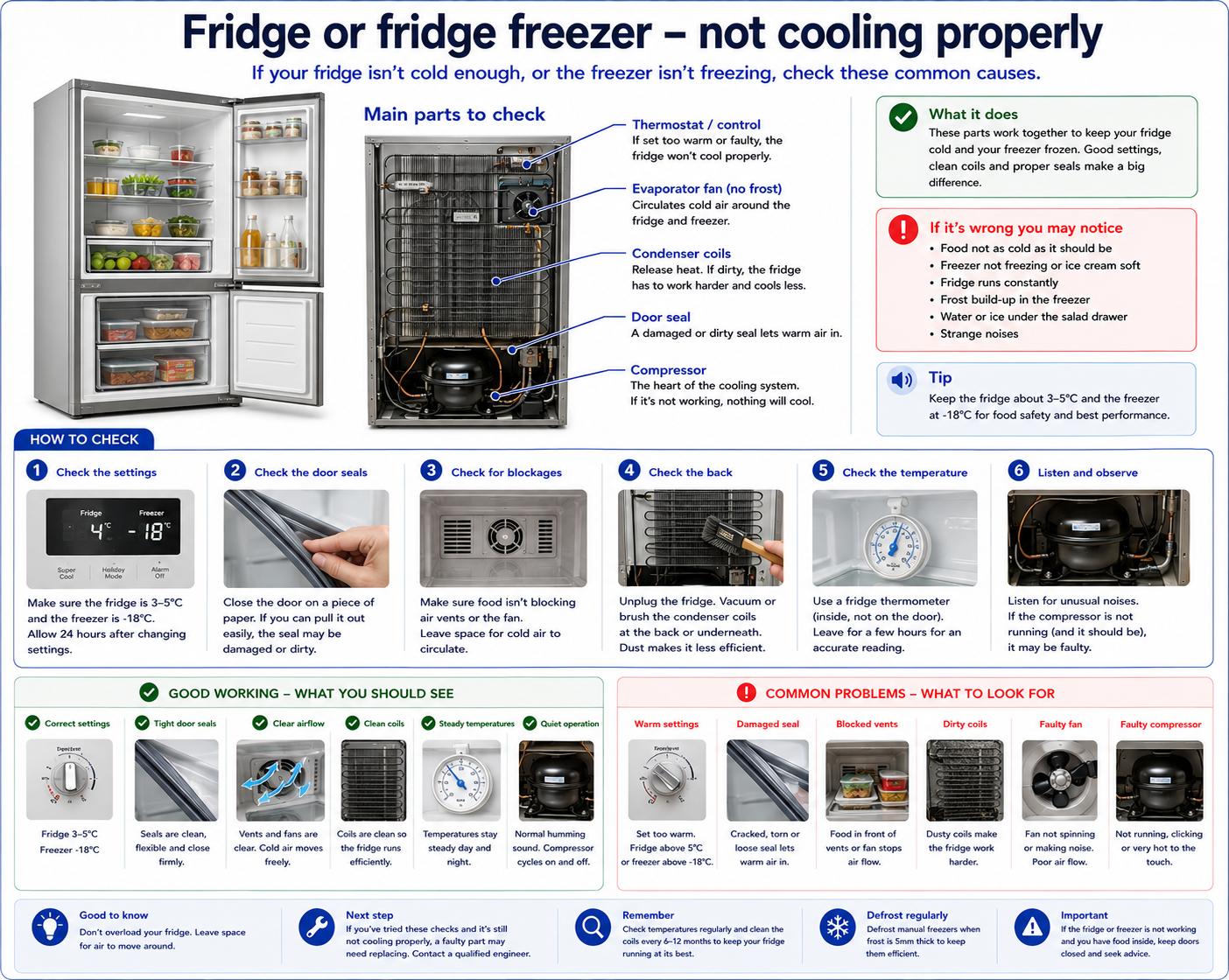
A fridge-freezer moves heat out of the cabinet with a sealed refrigeration circuit, fans, and a control that decides when the compressor runs. You can check doors, vents and dirt on the condenser. You cannot add gas, “recharge” it from a can, or puncture pipework — that work is for a qualified engineer and is regulated.
Reading this page does not start a chat. If you already have a diagnosis in progress, we will ask before replacing it.
Common problems
Short, honest explanations — not a parts catalogue. If it matches what you are seeing, you can take that wording into a diagnosis.
Fridge warm, freezer okay — or the reverse
Different compartments have different airflow. A blocked internal vent, a failed flap, or a fan that has iced solid can warm one side while the other still feels fine. Note which compartment failed and whether the back wall is iced over.
If you hear no compressor after several minutes, or it clicks every few seconds and gives up, that is not a “turn the dial up” problem. Keep the doors shut to save the food you have, and describe the sound.
Auto-defrost models drain melt water to a tray above the compressor. If that drain holes ices up, water appears in the fridge or on the floor. Never chip ice with a knife — you can puncture the evaporator.
A fridge should hum. A scream, knock, or rattle that started after you pulled it out to clean may just be a pipe touching the cabinet — but a dying fan or compressor has a different, constant pitch. Say when it makes the noise (during cooling, or all the time).
Over-cooling can be a thermostat, a damper stuck open to the freezer, or food sat against the back plate. It is the opposite of “not cooling” and needs that distinction in any diagnosis.
Switch the appliance off at the wall first unless the check is only looking at a display. Stop if anything in Stop and get help applies.
Door seal and loading
Close the door on a piece of paper: it should drag. Dirty or torn seals leak warm air and make ice. Do not pack the fridge so tight that internal vents are blocked.
Check setting, seal, space behind the cabinet, and dusty rear coils. Unplug before cleaning the back. Typical layout — yours may differ.
Space and condenser dust
Most UK freestanding models dump heat through coils or a rear panel. Pull the machine out (carefully, with help), unplug it, and vacuum dust from the back and the floor underneath. Leave a gap as the manufacturer specified — usually a few centimetres.
Temperature setting
Aim around 4 °C in the fridge and −18 °C in the freezer if you have a display. A holiday setting or a child-lock can look like a fault.
Stop and get help
These are the points where another cycle, another click, or a screwdriver makes things worse. ApplianceClinic is not a repair company and will not send an engineer to you.
Do not puncture or “regas”
Refrigerant circuit work is not a consumer job. Cans sold online are not a fix for a leaking system, and damaging the pipework writes the appliance off.
Electrical burning or trips
Unplug. A fridge that trips the supply can be the compressor or defrost heater.
You cannot keep food safe
If temperatures have been in the danger zone for hours, the food safety decision is yours — diagnosis will not make yesterday’s chicken safe.
Know your appliance
Names you may hear in a diagnosis, in plain language. This is identification, not a strip-down guide.
Compressor
The sealed motor that pumps refrigerant. It should get warm when running. Replacing it is an engineer job with recovery of refrigerant.
Evaporator fan
Moves cold air around. If it is iced still, you may hear silence in the freezer while the compressor runs.
Defrost heater and drain
Melts frost on auto-defrost models. When it fails, a glacier grows on the back wall. Do not chip it off.
Door seals (gaskets)
A cheap-feeling part that has a large effect. A torn seal is worth describing before anyone talks about a compressor.
Find your model number
Look inside the fridge — side wall, beside the salad drawers, or behind a kick plate. Some plates are on the rear. You want the model, not the litre capacity printed on the sales badge.
Take the photo with the door open in good light; condensation hides digits.
If you have an American-style double door, check both liners.
When you start a diagnosis, use the camera button on the composer to photograph the plate. Conversations stay in your browser — they are not published as web pages.
Safety recalls and notices
UK Office for Product Safety and Standards notices that may affect fridge-freezers. ApplianceClinic does not issue recalls — check the official record before you act.
The assistant is the same conversation as the homepage. Describe what you have already checked. It will not run in the background, and it needs a network connection.