You’re offline. This help page still works as a reference. A fresh AI diagnosis needs an internet connection.
Appliance help
Oven and cooker help
An oven is a box that must get hot evenly and stay sealed. Electric models use elements, a fan (on fan ovens), and a thermostat. Gas models add burners and a flame-supervision device. If you smell gas, this page does not ask you to diagnose anything — you leave, you ventilate, you call the emergency number.
Reading this page does not start a chat. If you already have a diagnosis in progress, we will ask before replacing it.
Common problems
Short, honest explanations — not a parts catalogue. If it matches what you are seeing, you can take that wording into a diagnosis.
Not heating, or only the grill works
A fan oven with a dead hidden element can still blow cold air. A grill that works while the oven does not often means a different element or a selector switch — useful to say up front. For gas, no click and no smell of gas at the burner is different from smell of gas.
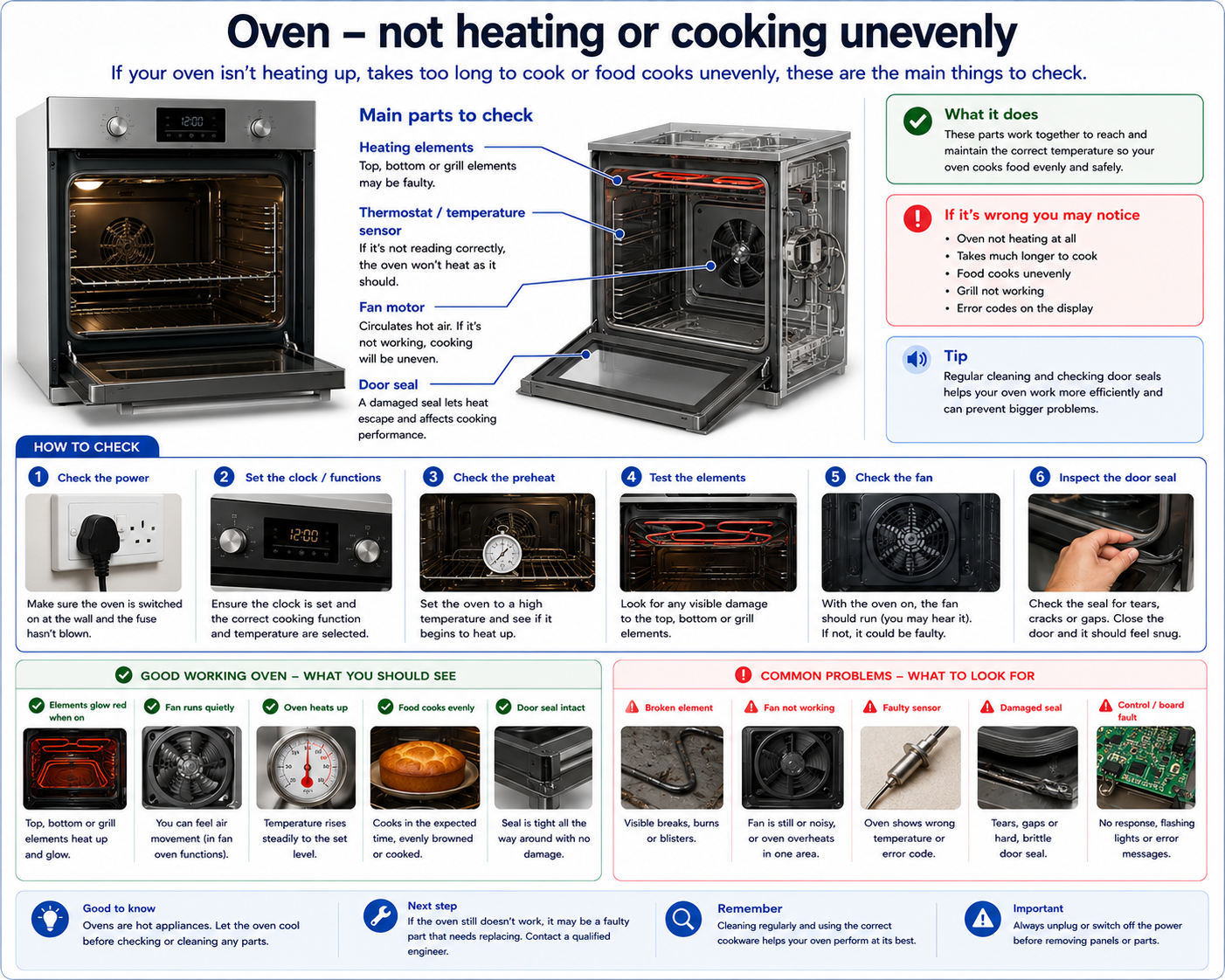
Fan, element, temperature sensor and door seal all take a share. A dropped door that no longer sits square leaks heat at the corners. This is identification first; swapping elements is an engineer job on a built-in, often hard-wired cooker.
Parts involved in even heating. This is a typical layout for identification — not a DIY strip-down guide. Your cooker may differ.
A shriek from the back of a fan oven is often the fan motor. Do not run a fan oven for hours with a seized fan: food will not cook evenly and the element can overheat locally.
A door that drops, a cracked inner glass, or a lock on a pyrolytic cycle that will not release are mechanical faults. Pyrolytic locks stay shut while the cavity is dangerously hot — wait for cool-down; do not force them.
Many ovens refuse to heat if the clock is unset after a power cut. That is not an element failure. If the display is dead on a hard-wired cooker, isolate at the wall switch and treat it as electrical.
Safe checks you can make
Switch the appliance off at the wall first unless the check is only looking at a display. Stop if anything in Stop and get help applies.
Power and the wall switch
Built-in ovens are often on a switched fused connection above a cupboard. Confirm that switch is on before assuming a dead element. Do not open the terminal block.
Door seal and shelves
A flattened or torn seal wastes heat. Shelves blocking the fan outlet in a fan oven give pale centres. These are observations, not wiring tests.
Gas: if cold, check the obvious only
If a gas oven does not light, you may look whether the cooker isolation valve is open — that is a handle, not a joint. If you smell gas, skip every check and follow the stop steps below.
Stop and get help
These are the points where another cycle, another click, or a screwdriver makes things worse. ApplianceClinic is not a repair company and will not send an engineer to you.
Smell of gas, faint hiss, or suspected leak
Do not use electrical switches, including the doorbell. Open windows, get out if the smell is strong, and call the Gas Emergency Services on 0800 111 999. Do not “find the leak” with a flame or by tightening joints.
Carbon monoxide concerns
Headache, nausea, sooty yellow gas flames that will not sit on the burner: stop using the appliance, ventilate, get fresh air, and seek medical advice if you feel unwell. Have gas appliances inspected by a Gas Safe engineer.
Sparks, burning, or a tripped cooker circuit
Leave it isolated. Cooker circuits are high current. Terminal-block burns on the back of a cooker are an engineer job, not a customer reseat.
Hot surfaces and pyrolytic
Do not reach into a pyrolytic cycle. Do not put tea towels on a hot hob above a cooker oven.
Know your appliance
Names you may hear in a diagnosis, in plain language. This is identification, not a strip-down guide.
Elements
Visible bottom/grill elements, or a hidden ring around the fan. ABOUT identification only on our diagrams — we will not walk you through live tests.
Fan motor
Sits behind the back panel of a fan oven. Replacement is a repair with the cooker isolated.
Gas burner and thermocouple
If the flame will not stay lit, the flame-supervision device may not be seeing heat. That is Gas Safe territory, not a DIY bypass.
Find your model number
Look around the door frame, behind a storage drawer, or on the rear (you may need to ease the cooker out with the supply isolated). Built-in ovens often have the plate on the frame once the door is open.
Note whether it is gas, electric, or dual fuel before you start a diagnosis.
A first-fix cooker switch being off is embarrassingly common — check it.
When you start a diagnosis, use the camera button on the composer to photograph the plate. Conversations stay in your browser — they are not published as web pages.
Safety recalls and notices
UK Office for Product Safety and Standards notices that may affect ovens and cookers. ApplianceClinic does not issue recalls — check the official record before you act.
The assistant is the same conversation as the homepage. Describe what you have already checked. It will not run in the background, and it needs a network connection.