You’re offline. This help page still works as a reference. A fresh AI diagnosis needs an internet connection.
Appliance help
Vacuum cleaner help
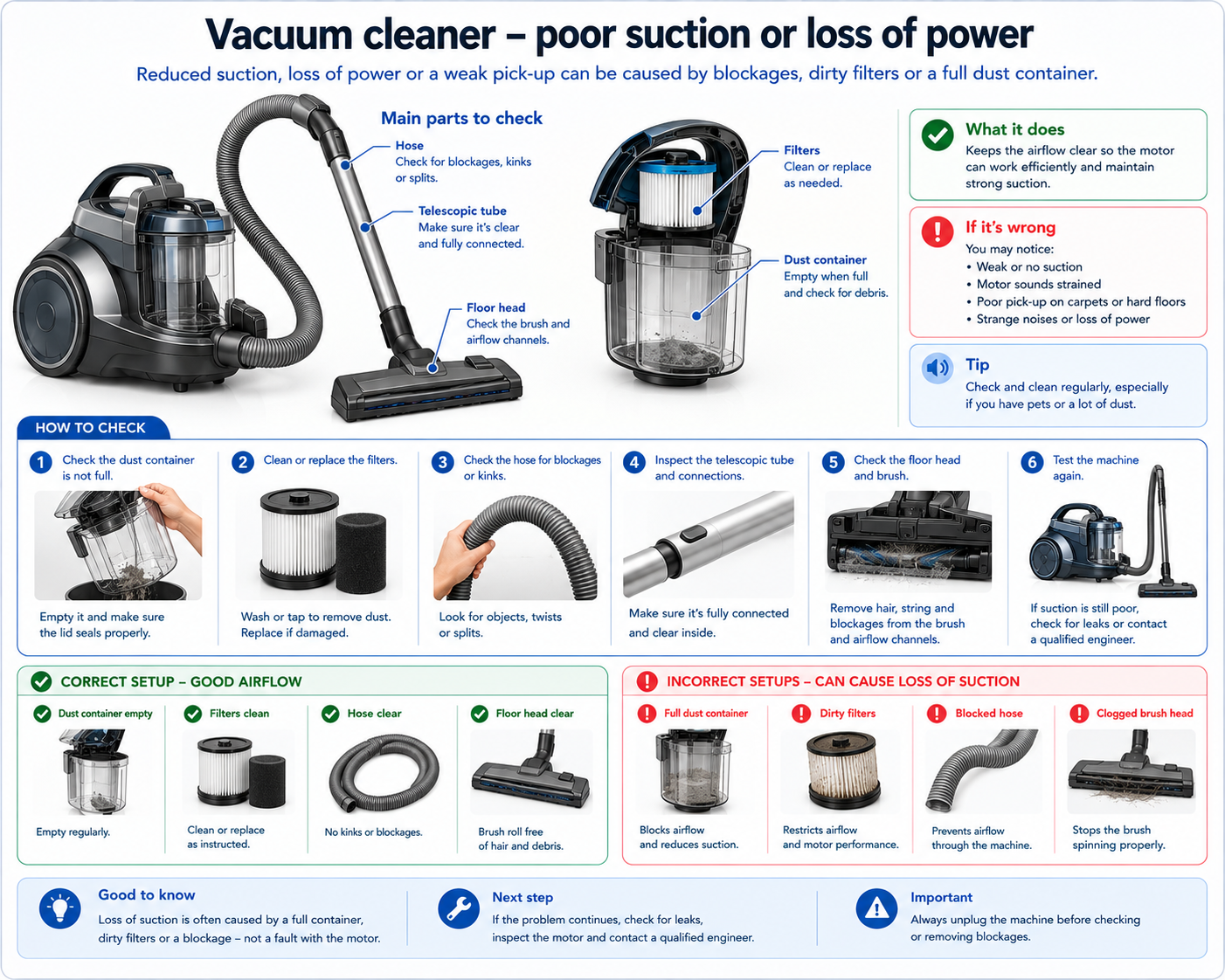
A vacuum is a fan (the motor) pulling air through a hose, filters, and a bag or bin. Loss of suction is almost always a full bin, a choked filter, or a blockage in the wand — not a “dead motor” — until those are cleared. Cordless models add a battery that can look like a motor fault when it is just empty or tired.
Reading this page does not start a chat. If you already have a diagnosis in progress, we will ask before replacing it.
Common problems
Short, honest explanations — not a parts catalogue. If it matches what you are seeing, you can take that wording into a diagnosis.
Weak suction
Work from the head back: clogged floor tool, blocked wand (a sock or Lego is a classic), full bag or bin, and filters packed with dust. A machine that sucks strongly at the hose inlet but not at the head has a blockage in the tools, not a new motor.
Empty the bin, clean filters as your model allows, and check the hose. Typical layout — cylinder, upright and cordless all differ.
Many motors have a thermal cut-out. A blocked machine runs hot and stops, then works again when cool. That is a blockage reminder, not a random electrical ghost. If it cuts out with a clean path, stop using it.
Hair around the roller, a belt (on some uprights), or a clutch that disengages on a stuck bar. Cut hair out with scissors, unplugged. Do not keep running a jammed brush motor.
Mains: check the socket with a lamp. Cordless: charge status and a flashing battery mean power, not floorhead. A completely dead cordless after a drop can be a battery pack or a broken switch — still not something to prize open if the pack is swollen.
Switch the appliance off at the wall first unless the check is only looking at a display. Stop if anything in Stop and get help applies.
Bin or bag, then filters
Empty the bin or replace the bag before anything clever. Wash only filters that the maker says are washable — some HEPA filters are dry-clean only and die if soaked. Dry washable filters fully before refitting or you will cook them.
Hose and wand
Drop a coin or look through the wand. Flexible hoses crush internally; a hose that looks open can still be blocked inside the corrugations.
Head and brush
Unplug. Cut hair off the roller. Check the suction inlet in the head is not taped over with a rug fringe.
Stop and get help
These are the points where another cycle, another click, or a screwdriver makes things worse. ApplianceClinic is not a repair company and will not send an engineer to you.
Swollen or leaking battery (cordless)
Do not charge it. Do not put it in household rubbish. Follow local battery disposal. A puffed pack is not a “keep using until it dies” part.
Sparks from the motor bay or a trip
Stop. That is not a filter.
Used on wet (unless it is a wet vac)
A dry vacuum that has sucked water is an electrical risk. Do not switch it back on to “dry it out”.
Know your appliance
Names you may hear in a diagnosis, in plain language. This is identification, not a strip-down guide.
Motor / fan
The only moving part that makes vacuum. It fails, but far less often than blockages. Replacing it varies wildly by brand and is often uneconomic on cheap cylinder vacs.
Filters
Protect the motor. A missing filter is how motors die young.
Battery pack
On cordless, a pack that holds seconds of charge is a wear part. It is not the same as a blocked head.
Drive belt (some uprights)
A burnt, slack belt stops the brush. Visible once the sole plate is off — only if your model is meant to be opened that way.
Find your model number
Look on the underside of the head, on the motor housing, or near where the hose enters the cylinder. Cordless sticks often hide the model in the battery well or on the wand.
Upright and cylinder plates are easy to get dusty — wipe before the photo.
Battery voltage on a pack is not the vacuum model number.
When you start a diagnosis, use the camera button on the composer to photograph the plate. Conversations stay in your browser — they are not published as web pages.
Safety recalls and notices
UK Office for Product Safety and Standards notices that may affect vacuum cleaners. ApplianceClinic does not issue recalls — check the official record before you act.
The assistant is the same conversation as the homepage. Describe what you have already checked. It will not run in the background, and it needs a network connection.